Breathing Building: Art at the Leper Chapel
By Francesca Tomlinson
An Artist’s Diary at The Leper Chapel: Art, Social History and Storytelling in Cambridge
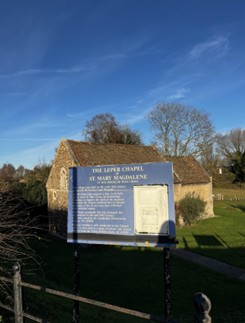
The Leper Chapel of Saint Mary Magdalene is one of the oldest surviving buildings in Cambridge. Over the centuries, it has had many lives: a place of worship, a store room, a pub, a home, even a stable!
As a practicing artist and postgraduate student at Anglia Ruskin University, I was drawn to the layered history of the chapel and the stories I might uncover through art making.
Forgotten histories at the Leper Chapel Cambridge
When I first began researching the chapel, I found a wealth of information about the building itself – who owned it, how it changed architecturally and how it was repurposed over time.
But what really caught my attention was something else… I found that the people who used it in its earliest days were much harder to trace.
The chapel was originally associated with a leper hospital, serving a community living on the fringes of medieval society. These were people managing a range of visible conditions – not just Hansen’s disease, but others like psoriasis or smallpox – and although pushed to the margins, they remained part of a wider social and spiritual fabric, held in a space between exclusion and care.
And yet, despite their central role in the community at the time, very little is known about them as individuals.
Rather than seeing this as a gap, I began to think of it as a “negative archive” that could be explored through my creative practice.
In dialogue with a historic Cambridge building
Rather than trying to “solve” the history of the leper community who once worshipped here, I spent time in the space – visiting over the course of a year, witnessing the site change throughout the seasons. I wanted to see what the chapel might reveal about itself.
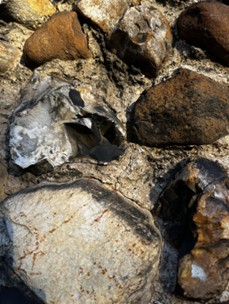
Up close, there’s so many beautiful tactile elements – bumps, stones, tiles, bricks all shaped by hands, feet, weather and time. The surfaces are full of marks and clues: layers of paint, traces of old features such as archways, windows and grotesque gothic figures… even graffiti scratched into the bricks way back in 1843!
My understanding of the chapel also grew through wonderful conversations with staff and volunteers from Cambridge Past, Present & Future, who shared fascinating stories that weren’t recorded in formal archives.
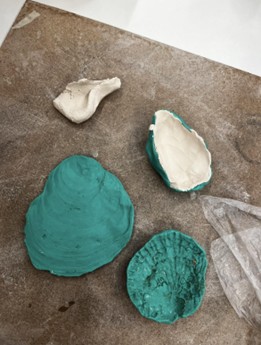
My favourite of these is about an excavation of the site where large quantities of oyster shells were uncovered – obviously linking back to the history of Stourbridge Fair. This would later inform the outcome of my artwork and the curation of the exhibition.
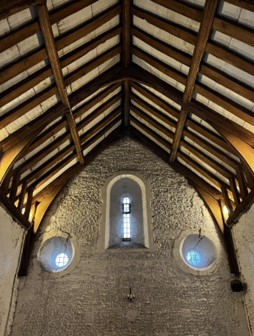
In another conversation, the western wall was described as something that quite literally breathes, expanding and contracting over time.
These glimpses made the chapel seem more and more like a living being. I began to feel as though I was getting to know the building, like a friend slowly revealing themselves.
Working in this way connects to broader practices of site-responsive art within historic buildings, where meaning emerges through direct engagement with the space, conversations and lived experience.
From research to making: leper bells and social history
One idea kept returning as I worked: the leper bell.
Historically, these bells were used to announce the approach of patients, often as a warning. It’s a powerful symbol, tied up with themes of social segregation, identity and ritual.
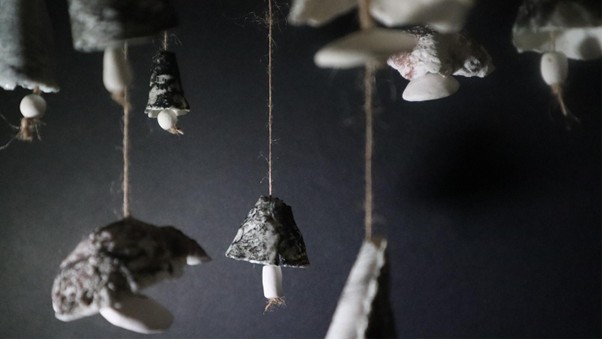
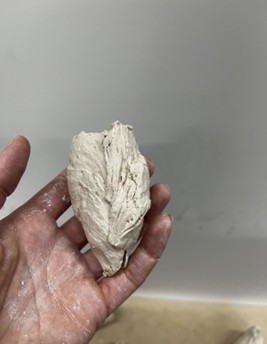
For this project, I wanted to rework that symbol through a material-led process, where the building itself becomes part of the language of the work. Instead of simply recreating the bells with historical accuracy, I began reimagining them as a series of small, hollow ceramic forms – with the shape and texture of each form coming from the chapel itself.
Using non-toxic putty, I took moulds from the flint stones in the west wall, as well as oyster shells, and then used those impressions to create paper porcelain bells.
I also took simple wax crayon rubbings of the surfaces inside and outside the chapel. My coursemate and fellow artist Aeron Hall-Apps showed me how to use these in a wax resist printmaking technique, and I started experimenting with applying these abstract patterns to the clay body.
These methods meant each bell carries the surface of the building in its own way – like a skin. Each one is unique and characterful, which I think respectfully honours the patients from the isolation hospital. An object which was historically rung as a warning became a vessel for reflection and community.
Making site-responsive art: unpredictable sounds
Working with these materials was full of surprises. Some of the bells ring softly. Others don’t ring at all – more of a jarring clink than a chime. At first, this felt like a problem, but over time it became part of the work.
These variations – with some resonating and others producing muffled, obscure sounds – started to feel meaningful. It reflected something of the chapel’s history: a place where some stories are clear and others are harder to understand.
Working with a living heritage site
Working in a site like the Leper Chapel Cambridge is very different from a traditional “white cube” gallery space. These ancient buildings come with their own histories, responsibilities and limitations – and as an artist, you’re stepping into something that already exists, rather than starting from a blank slate.
Today, Cambridge Past, Present & Future are custodians of the chapel, caring for it on behalf of future generations. It remains an active community space, used for events and services, so any work installed had to respect both the building and the people who continue to use it.
There are practical challenges too. As a listed building, nothing can be fixed permanently to its walls. Every decision (material, placement, scale etc.) had to be carefully considered.
To me, these constraints are part of what makes working in historic spaces so rewarding. They push you to think differently, to adapt and to respond more sensitively and deeply. It was a real privilege to contribute, even in a small way, to the ongoing life of the chapel.
More broadly, I’ve noticed a growing number of artists engaging with non-traditional and heritage spaces – often out of necessity as well as choice. At a time when access to space (particularly studio space) can feel like a privilege, these kinds of collaborations open up new possibilities for emerging artists such as myself.
Why the Leper Chapel Cambridge needs protecting
Despite its rich history, the chapel is currently on Historic England’s Heritage at Risk Register.
Engaging with the chapel through contemporary art is one way of drawing attention to its significance – not only architecturally, but as a site closely linked to community and social history.
This project also comes at an important moment. The Leper Chapel Cambridge is the focus of a funding application led by Cambridge Past, Present & Future to support urgent conservation work, including repairs to the roof and structure.
If you’re able to, please consider making a donation or taking out a membership of CPPF. Donations will help safeguard the chapel for future generations and ensure it continues to be a space for community, history and creativity.
Art exhibition at the Leper Chapel Cambridge
This project will be presented at an exhibition called breathing building at the Leper Chapel Cambridge 15-17 May – offering visitors the chance to experience both the work and the building together.
Over the course of the exhibition, the chapel becomes part of the installation itself. The bells – formed from its mottled surfaces – sit within the space that shaped them, creating a dialogue between material, memory and place.
This will be my first solo exhibition, a culmination of over a year of making, testing and conversations, in collaboration with Cambridge Past, Present & Future.
About the artist
Francesca Tomlinson is a Cambridge-based multidisciplinary artist whose work explores historic sites, archives and socially charged objects to uncover overlooked histories and connect them to life today.
For more information about the artist, visit:
www.francescatomlinson.com