Cambridge South: what is being proposed?
A major new development is being proposed on the southern edge of Cambridge, and a public consultation is taking place this October.
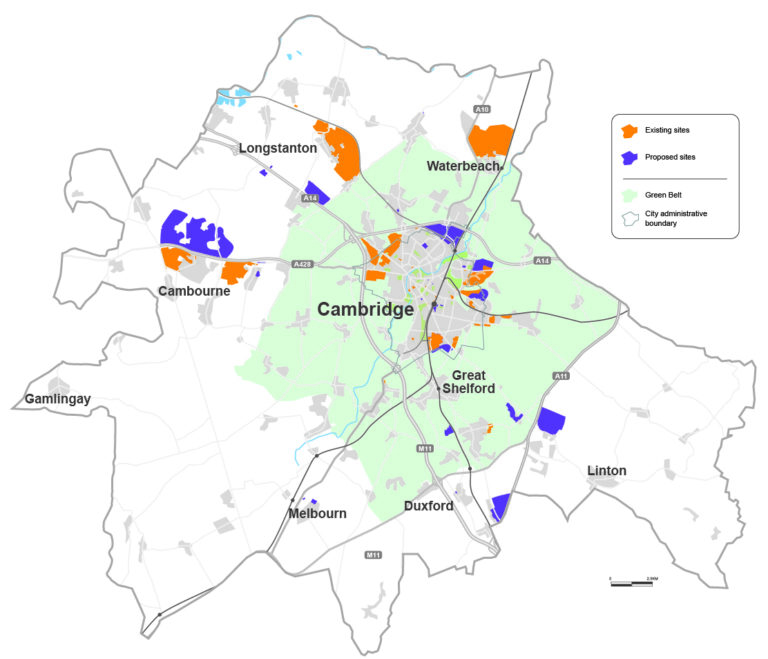
Known as Cambridge South, the emerging proposal from Pigeon and Lands Improvement is for a new mixed-use community on land between Cambridge and Great Shelford and the M11, not far from the Cambridge Biomedical Campus.
The proposals include around 4,000 new homes, including 50% affordable housing, alongside schools, healthcare, shops and community facilities. The promoters also propose new walking and cycling connections, access to Cambridge South station and the Guided Busway, and a new Country Park along the River Cam.
These are potentially significant proposals for Cambridge and its surrounding countryside. By going out to consultation now, the site promoters are likely working up their plans to influence the local councils and the Greater Cambridge Development Corporation as to where long-term development should take place. The Development Corporation will be responsible for delivering significant growth by 2050. They will take over deciding strategic planning applications next year and preparing a new Local Plan at a later date.
But what is the current planning status of this land, and how can local people have their say?
Is Cambridge South in the Green Belt?
Yes. All of the land being promoted for Cambridge South is currently designated as Cambridge Green Belt.
Is Cambridge South allocated for 4,000 homes in the Local Plan?
No, it is not allocated in either the current adopted Local Plan or its replacement draft Greater Cambridge Local Plan.
Cambridge South is a developer-promoted proposal. Pigeon and Lands Improvement are promoting the site through the Greater Cambridge Local Plan process and seeking its allocation for development.
That does not mean the proposals will necessarily proceed, nor that the land has already been allocated for a new settlement of this scale.
The planning status matters because decisions about where Cambridge grows, and what happens to the Green Belt around it, have long-term consequences.
What is the case being made for Cambridge South?
Pigeon and Lands Improvement, who are promoting Cambridge South on behalf of the landowners, argue that development here could help meet Cambridge’s housing and employment needs while supporting the continued growth of the nearby Cambridge Biomedical Campus.
Their case rests partly on location. The site is close to the major employment at the Biomedical Campus, Cambridge South railway station and existing public transport routes. The promoters argue that locating homes close to jobs and transport could reduce the need for longer-distance commuting.
However, while government policy generally supports granting planning permission for homes within a reasonable walking distance (around 800 metres or a 10-minute walk) of well-connected stations, this site lies beyond that distance and cannot rely on this policy.
The emerging proposals also include 50% affordable housing, (which is government policy for residential development in the Green Belt), schools, healthcare, shops and community facilities, alongside new walking and cycling connections and a Country Park along the River Cam.
In previous representations to the Greater Cambridge Local Plan, the landowners and promoters have also argued that development could deliver biodiversity gains and new publicly accessible green space, and that Cambridge South could be planned as an integrated new community rather than as piecemeal development.
These are the arguments being put forward by those promoting the site. They need to be considered alongside the planning evidence about the site’s Green Belt role, landscape impacts and the separation between Cambridge and Great Shelford.
What are the key points to consider?
The proposal raises significant questions, particularly because of the site’s current planning status and long-term impact on the area. As local people review the proposals, there are several key planning and environmental issues to weigh up:
- Green Belt: The proposed site lies entirely within the Cambridge Green Belt. The implications of development for the purposes of the Green Belt, including the separation between Cambridge and Great Shelford, will therefore be an important planning consideration.
- Water scarcity and environmental limits: Greater Cambridge faces well-documented water supply constraints and pressure on local chalk streams. A key question for any proposal of 4,000 homes is where the additional water supply will come from and how local ecology will be protected.
- Cumulative growth on the southern fringe: The southern edge of Cambridge has already seen significant growth, including the Biomedical Campus expansion and nearby housing developments. What will be the combined impact of another major scheme on local infrastructure, traffic congestion, and the overall character of the southern fringe?
- Transport and walking distances: While proximity to public transport is highlighted by the promoters, the site lies beyond the standard 800-metre walking distance to Cambridge South station. A key consideration is whether residents would realistically rely on walking and cycling, or if the scheme would add significant vehicular traffic to already busy local roads.
- The Country Park proposal: The promoters propose a new Country Park along the River Cam as a major public benefit. It will be important to consider how much of this land is already protected countryside or floodplain, and whether a new park adequately offsets the loss of existing open Green Belt.
- Strategic planning process: The site was not allocated in the Draft Greater Cambridge Local Plan. Looking ahead, the Government’s Greater Cambridge Development Corporation will prepare its own local plan for long-term growth once the main Local Plan is adopted. You may want to consider how developer-led consultations fit alongside the official, evidence-based local plan process.
There are also further questions to explore around biodiversity, local school provision, healthcare, and water infrastructure. These are precisely the kinds of questions that the upcoming public consultation provides an opportunity to test.
Why we’re talking about it now
The Cambridge South proposals are at an early stage.
Pigeon and Lands Improvement are holding two public consultation events in October:
Monday 5 October, 3pm–7pm
Shelford Rugby Club, Cambridge Road, Great Shelford, CB22 5JJ
Saturday 10 October, 10am–2pm
Little Shelford Memorial Hall, 13 Church Street, Little Shelford, CB22 5HG
The proposals can also be viewed online and comments submitted through the Cambridge South consultation website[ https://cambridgesouth.co.uk/].
We would encourage anyone interested in the future of Cambridge and its surrounding countryside to look at the proposals and take part.
Helping Cambridge understand change
Cambridge Past, Present & Future has been involved in influencing the growth and development of Cambridge for nearly a century.
Part of our role today is to help people understand the changes being proposed around them: what is planned, what isn’t, what protections currently apply, and what the arguments are on different sides.
Major development proposals can be complicated. Planning documents are often, lengthy, technical and difficult to navigate, while public consultations understandably present the case for a particular proposal.
We want to help bridge that gap.
That means explaining significant proposals early, examining the evidence, asking questions and encouraging more people participate in decisions about the future of Cambridge and its surroundings.
Cambridge is changing. We want more people to understand how, and to have the opportunity to help shape what happens next.